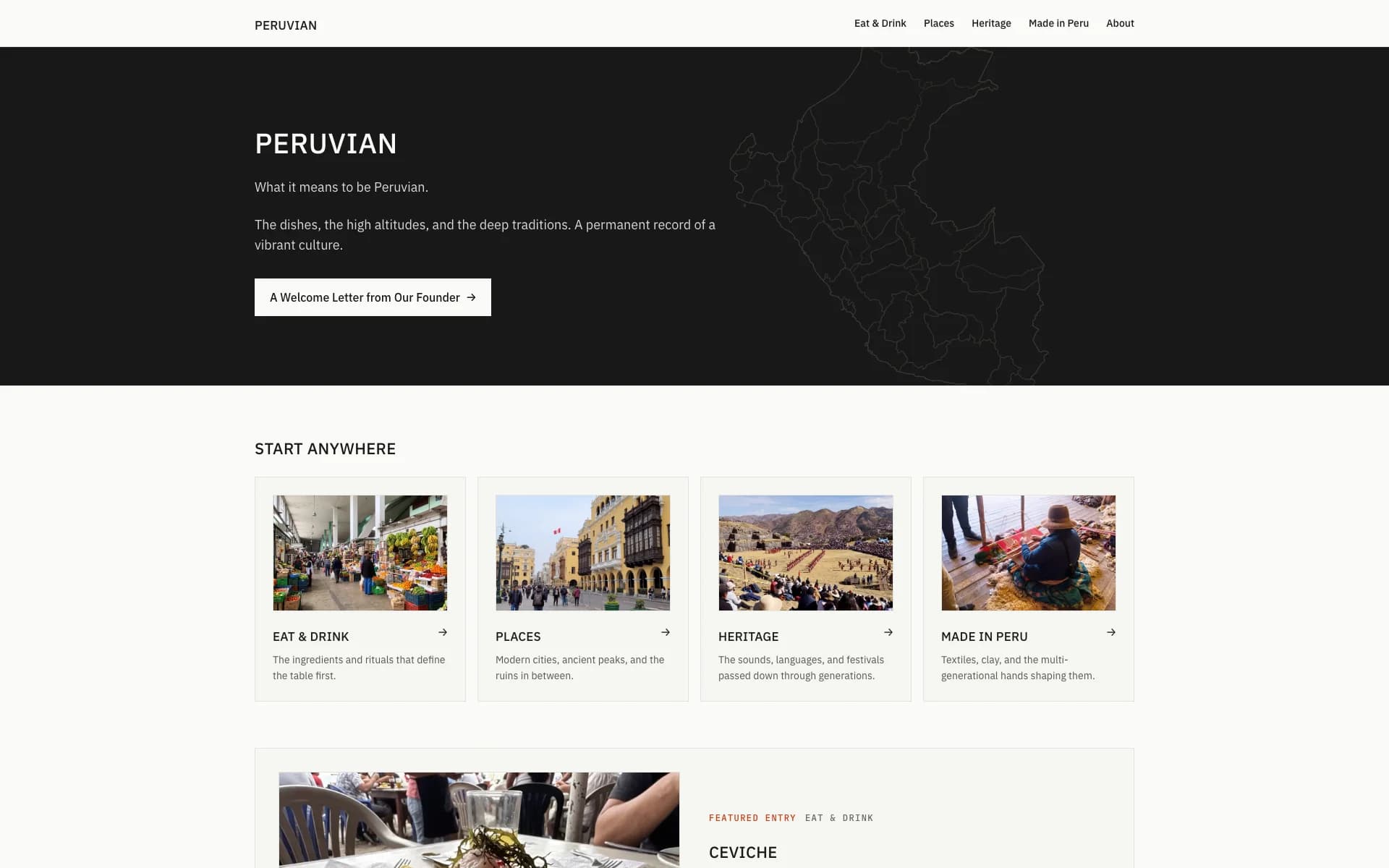
Peruvian is a deeply personal passion project. I built it with AI agents, deciding what Peruvian should be, turning that point of view into rules, and learning which decisions I could delegate and which still needed me.
It is a growing catalog of the food, places, languages, and crafts that shape Peruvian culture. It keeps the original Spanish and Quechua names intact and gives each subject enough room to be understood on its own.
- Role
- Product designer, builder, founder
- Timeline
- October – November 2026
- Models
- Claude (copy, taste, and review), Gemini (structural logic), lighter models (wiring and operations)
- Status
- Live in English; Spanish edition currently in progress.
01 / ORIGIN
Giving the idea a purpose
"Peruvian" is a large word. I needed to decide what the site could honestly do without flattening an entire culture into a slogan.
My family is Peruvian, and the site is about our culture. I talked the idea through with them because their reactions were part of deciding what felt true, what felt reductive, and what was worth making.
I also own IncaTrail.com and Saborear.com. I built Peruvian as a funnel that works both ways: readers can move from here to travel or cook, while IncaTrail and Saborear can send them back here to learn more. That strategy is why outbound links are part of the experience, never ads.
02 / EXPERIENCE
Refining what the agents made
The site at first opened with a call to action to explore the site. A personal welcome was the better way to earn trust and invite people onto the journey while I figure it out. Now it opens with an invitation to read an open letter from me, its founder.





03 / WORKFLOW
Learning where judgment belongs
I turned the product intent into a brief the agents could follow and the tests could inspect. The workflow changed whenever an agent exposed a gap between speed and judgment.
- Routing: I chose Grok 4.7 for operational work to manage cost, then switched to Fable to assess which model should handle each kind of task. Lighter models now handle repetition and syntax; reasoning models handle voice, taste, the brief, and test design.
- Template: One content schema and one entry component give repetitive work a fixed shape, which makes it easy to delegate and makes deviations obvious.
- Secrets: Keys live outside the checkout and outside the model's context; the first botched handoff became the rule to prepare secret files before they are needed.
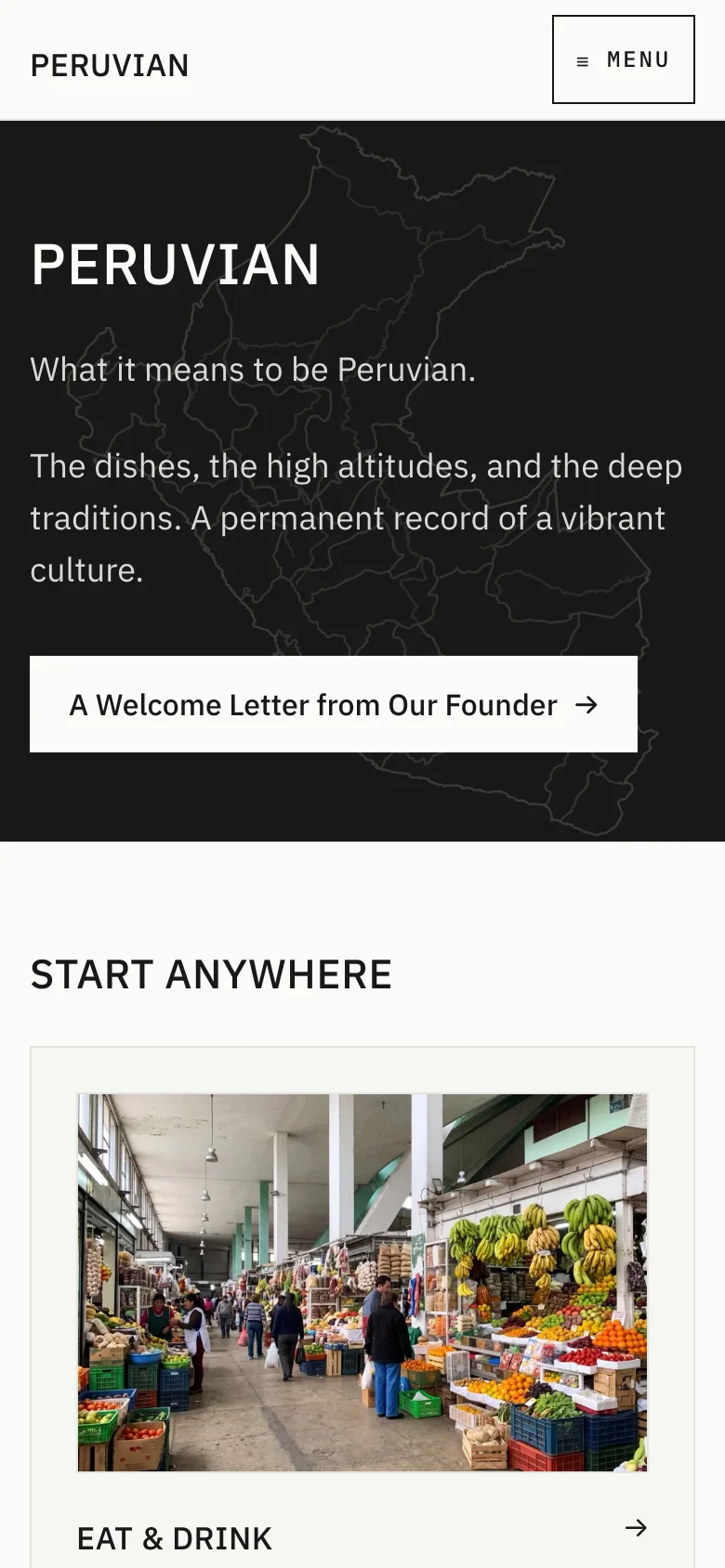
- Language: I built a language switcher to share across all three properties, Peruvian, Inca Trail and Saborear. English is reviewed and approved before it is translated into Spanish.
Peruvian carries sentimental weight, and follows a practical standard for working with agents: make the intent explicit, inspect the places where judgment matters, and turn failures into better rules for the next pass.
The product can grow one entry and one language at a time without giving up the care that made it personal.
From idea to production, with AI as a collaborator.

Discover
Understand the problem
Step 1: Frame the idea
Problem, audience, desired outcome
Step 2: Explore together
Questions, alternatives, tradeoffs
Step 3: Validate assumptions
Research, feasibility, evidence (AI research - I decide)


Define
Set the direction
Step 4: Define the product
Requirements and success criteria
Step 5: Plan the work
Milestones, tasks, acceptance tests. AI drafts
Step 6: Approve the plan
I revise scope before work begins. My approval.
Deliver
Build, verify, release
Step 7: Build + review loop
Implement, agent audit, fix, recheck (AI and agents)
Step 8: Connect + test
Services, env setup, staging QA
Step 9: Ship + learn
I approve release; we iterate. My approval
I use AI throughout the product development process, from exploring an idea and challenging assumptions to defining requirements, building, and reviewing the implementation.
But I don’t want a model that simply agrees with me. I expect it to question decisions, identify tradeoffs, and provide evidence that the work actually functions.
I review the plan, direct the experience, and use independent agents to help verify the implementation. Before release, I test the product and make the final call.
AI makes it possible to move much faster. My responsibility is making sure we’re moving in the right direction.